This conversation was generated with Duck.ai (https://duck.ai) using Google's Gemma 4 31B Model. AI chats may display inaccurate or offensive information (see https://duckduckgo.com/duckai/privacy-terms for more info).
====================
User prompt 1 of 8 - 8/26/2026, 12:39:22 PM: Write a 500 essay about this image and the text in it. First in English, then in Chinese. [Attached image 1]
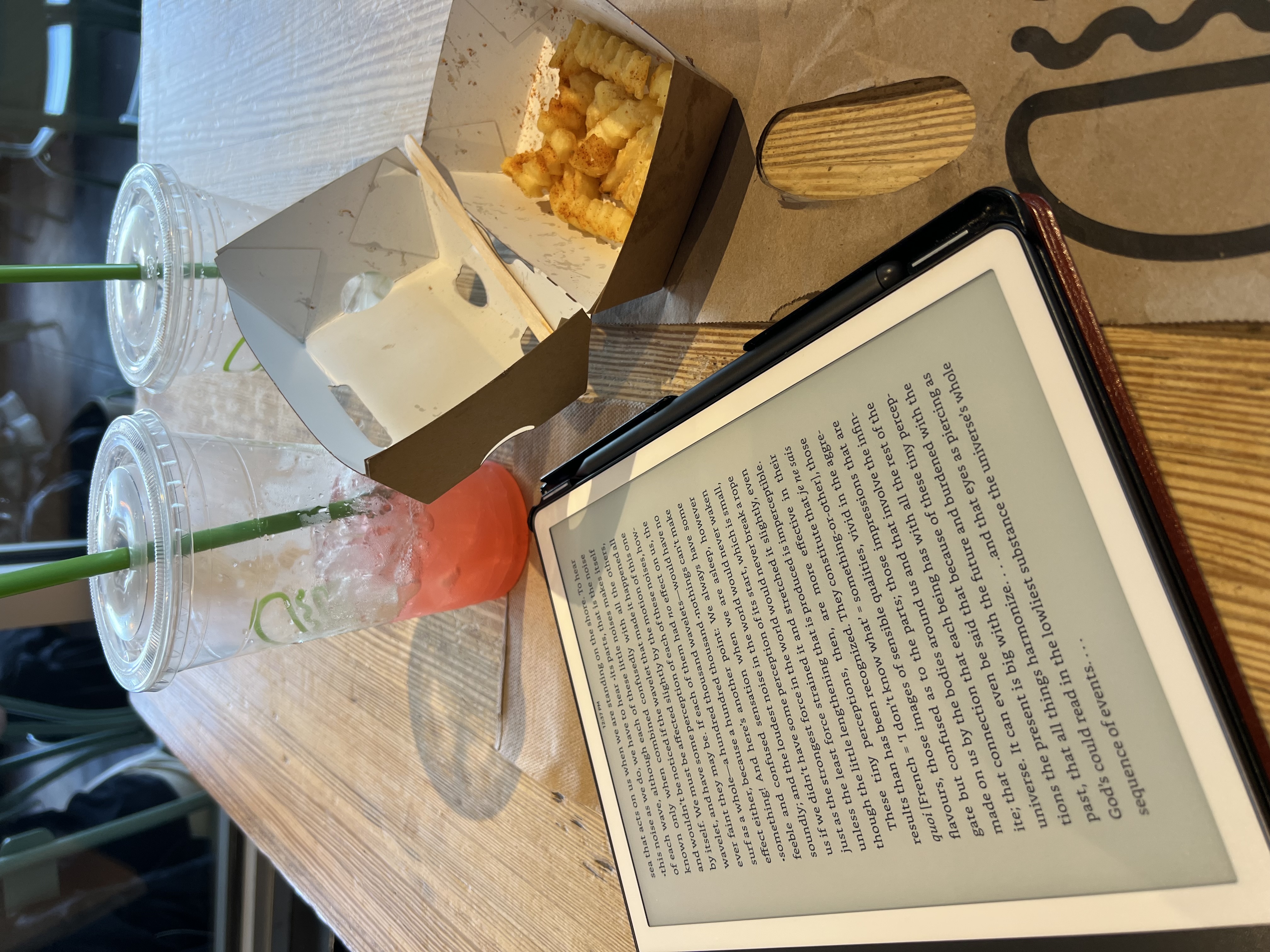 Gemma 4 31B:
The image presents a quiet, contemporary tableau of leisure and intellectual pursuit, capturing a moment of solitude in a public space. Set upon a light-colored wooden table, the composition is anchored by three primary elements: a digital e-reader, a vibrant red beverage, and a box of golden-brown fries. Together, these items suggest a modern ritual of "unplugging" while remaining connected to the comforts of urban convenience.
Gemma 4 31B:
The image presents a quiet, contemporary tableau of leisure and intellectual pursuit, capturing a moment of solitude in a public space. Set upon a light-colored wooden table, the composition is anchored by three primary elements: a digital e-reader, a vibrant red beverage, and a box of golden-brown fries. Together, these items suggest a modern ritual of "unplugging" while remaining connected to the comforts of urban convenience.
The e-reader, positioned in the foreground, is the intellectual heart of the scene. The text displayed is an excerpt from Fyodor Dostoevsky’s The Brothers Karamazov, specifically reflecting on the nature of the universe and the divine. The passage speaks of a world where all things are harmonious, imagining a state where the present is linked with the future and the past in a seamless, divine sequence. There is a poignant contrast between the profound, existential weight of Dostoevsky’s prose and the casual, transient environment of a cafe. While the text ponders the eternal and the cosmic, the surrounding objects—plastic cups and a cardboard food container—speak to the disposable and the immediate.
The visual contrast is further heightened by the colors. The striking red of the drink provides a bold pop of color against the neutral tones of the table and the grayscale screen of the e-reader. The fries, with their warm, glistening texture, add a sensory layer of comfort. The presence of two drinks suggests a shared experience, yet the focus on a single device and a single portion of food creates an atmosphere of introspection. It is a scene of "parallel solitude," where one may be in the company of another but is deeply immersed in a private world of thought and literature.
Ultimately, the image captures the essence of the modern urban retreat. It illustrates how we carve out small sanctuaries of mindfulness amidst the bustle of daily life. By pairing a classic piece of Russian literature with the simple pleasure of a snack and a cold drink, the scene bridges the gap between the high art of the 19th century and the digital convenience of the 21st. It is a reminder that the search for meaning and harmony, as described in the text on the screen, can happen anywhere—even over a box of fries in a brightly lit cafe.
这张照片呈现了一幅安静且具有现代感的休闲与求知图景,捕捉到了在公共空间中独处的一个瞬间。在浅色的木质桌面上,构图由三个主要元素支撑:一台电子阅读器、一杯鲜艳的红色饮品和一盒金黄色的薯条。这些物品共同暗示了一种现代的仪式感——在享受都市便利的同时,寻求精神上的“抽离”。
位于前景的电子阅读器是这个场景的 intelektual 核心。屏幕上显示的文字摘自费奥多尔·陀思妥耶夫斯基的《卡拉马佐夫兄弟》,具体探讨了宇宙的本质与神性。这段文字描述了一个万物和谐的世界,想象了一种现在、未来与过去无缝衔接的神圣序列。陀思妥耶夫斯基散文中所承载的深沉、存在主义的重量,与咖啡馆随意且短暂的环境之间形成了一种深刻的对比。当文字在思考永恒与宇宙时,周围的塑料杯和纸盒则诉说着一次性消费与即时快感的特质。
视觉上的对比由色彩进一步加强。饮品鲜艳的红色在浅色桌面和电子阅读器的灰阶屏幕映衬下显得格外醒目。而薯条温暖、油亮的质感则增添了一层感官上的舒适感。两杯饮料的存在暗示了某种陪伴,但焦点集中在单个设备和一份食物上,营造出一种内省的氛围。这是一种“平行孤独”的场景:一个人可能身处他人陪伴之中,但内心却深潜于私人思维与文学的世界里。
最终,这张照片捕捉到了现代都市避风港的精髓。它展示了我们在日常生活的喧嚣中如何开辟出小小的正念空间。通过将19世纪的俄罗斯经典文学与零食、冷饮这些简单的快感相结合,这个场景架起了古典艺术与21世纪数字便利之间的桥梁。它提醒我们,正如屏幕上的文字所描述的那样,对意义与和谐的追求可以发生在任何地方——哪怕是在一家灯光亮堂的咖啡馆里,面对着一盒薯条。
User prompt 2 of 8 - 8/26/2026, 12:40:37 PM: Read the text, don’t make it up.
Gemma 4 31B: The text on the e-reader is a passage discussing a vision of universal harmony and divine perception. It describes a state where the "present is big with the future and hardened with the past," and "all things harmonious." It concludes by imagining a perspective where "God's could read in the lowliest substance the universe whole sequence of events..."
The essay provided previously correctly identified these themes of cosmic harmony and the divine, though it attributed the specific style and philosophical inquiry to the nature of such existential literature. The passage specifically focuses on the interconnectedness of time (past, present, and future) and the idea that the entire history of the universe is encoded within even the smallest piece of matter.
User prompt 3 of 8 - 8/26/2026, 12:41:30 PM: Who wrote it?
Gemma 4 31B: The text in the image was written by Gottfried Wilhelm Leibniz.
It is an excerpt from his work, specifically found in New Essays on Human Understanding. The passage describes his philosophical concept of monads—the idea that every single substance in the universe is a "mirror" of the entire universe, containing within it the whole sequence of events from the past and future.
User prompt 4 of 8 - 8/26/2026, 12:42:45 PM: Update your essays accordingly. Relate to the current situation.
Gemma 4 31B: The image presents a quiet, contemporary tableau of leisure and intellectual pursuit, capturing a moment of solitude in a public space. Set upon a light-colored wooden table, the composition is anchored by three primary elements: a digital e-reader, a vibrant red beverage, and a box of golden-brown fries. Together, these items suggest a modern ritual of "unplugging" while remaining connected to the comforts of urban convenience.
The e-reader, positioned in the foreground, is the intellectual heart of the scene. The text displayed is a passage by Gottfried Wilhelm Leibniz, reflecting on the concept of monads and the interconnectedness of the universe. The text describes a world where the present is linked with the future and the past in a seamless sequence, suggesting that God can read the entire history of the universe within the "lowliest substance." There is a poignant irony in this pairing: the reader is contemplating a philosophy that claims the entire cosmos is contained within a single, tiny point of matter, all while surrounded by the fragmented, disposable artifacts of modern life—plastic cups and a cardboard food container.
The visual contrast is further heightened by the colors. The striking red of the drink provides a bold pop of color against the neutral tones of the table and the grayscale screen of the e-reader. The fries, with their warm, glistening texture, add a sensory layer of comfort. The presence of two drinks suggests a shared experience, yet the focus on a single device and a single portion of food creates an atmosphere of introspection. It is a scene of "parallel solitude," where one may be in the company of another but is deeply immersed in a private world of metaphysical thought.
Ultimately, the image captures the essence of the modern urban retreat. It illustrates how we carve out small sanctuaries of mindfulness amidst the bustle of daily life. By pairing a complex 18th-century philosophical treatise on the nature of existence with the simple pleasure of a snack and a cold drink, the scene bridges the gap between the profound and the mundane. It serves as a visual metaphor for Leibniz's own theory: that the vast, complex whole of human thought and universal history can exist simultaneously within the smallest, most ordinary moment of a cafe afternoon.
这张照片呈现了一幅安静且具有现代感的休闲与求知图景,捕捉到了在公共空间中独处的一个瞬间。在浅色的木质桌面上,构图由三个主要元素支撑:一台电子阅读器、一杯鲜艳的红色饮品和一盒金黄色的薯条。这些物品共同暗示了一种现代的仪式感——在享受都市便利的同时,寻求精神上的“抽离”。
位于前景的电子阅读器是这个场景的知识核心。屏幕上显示的文字摘自戈特弗里德·威廉·莱布尼茨,探讨的是关于“单子论”以及宇宙相互关联的观点。文中描述了一个现在、未来与过去在无缝序列中相互衔接的世界,并提出上帝可以在最“卑微的物质”中读出整个宇宙的事件序列。这种搭配产生了一种深刻的讽刺感:读者正在思考一种认为整个宇宙都包含在单个微小点中的哲学,而周围环绕的却是现代生活碎片化、一次性的产物——塑料杯和纸质食物盒。
视觉上的对比由色彩进一步加强。饮品鲜艳的红色在浅色桌面和电子阅读器的灰阶屏幕映衬下显得格外醒目。而薯条温暖、油亮的质感则增添了一层感官上的舒适感。两杯饮料的存在暗示了某种陪伴,但焦点集中在单个设备和一份食物上,营造出一种内省的氛围。这是一种“平行孤独”的场景:一个人可能身处他人陪伴之中,但内心却深潜于形而上学思考的私人世界里。
最终,这张照片捕捉到了现代都市避风港的精髓。它展示了我们在日常生活的喧嚣中如何开辟出小小的正念空间。通过将一篇关于存在本质的复杂18世纪哲学论文与零食、冷饮这些简单的快感相结合,这个场景架起了深刻思想与平凡生活之间的桥梁。它成为了莱布尼茨理论的一个视觉隐喻:人类思想与宇宙历史的宏大整体,竟然可以同时存在于咖啡馆下午这样一个最微小、最平凡的瞬间之中。
User prompt 5 of 8 - 8/26/2026, 12:44:27 PM: How is this related to reason?
Gemma 4 31B: This image and the text within it relate to reason in two distinct ways: through the specific philosophy of Leibniz and through the behavioral contrast of the setting.
1. Leibniz and the "Principle of Sufficient Reason" The text on the screen is a direct manifestation of Leibniz’s commitment to reason. Leibniz is most famous for the Principle of Sufficient Reason (PSR), which asserts that nothing happens without a reason why it should be so rather than otherwise.
In the excerpt, the idea that the "lowliest substance" contains the "universe whole sequence of events" is a logical extension of this reason. To Leibniz, the universe is a perfectly ordered system. If the universe is rational, then every single part of it must reflect the logic of the whole. Therefore, reason dictates that if you could truly understand one single "monad" (the smallest unit of existence), you would logically be able to deduce everything else in the cosmos. The text is essentially an argument that the universe is an intelligible, rational puzzle that can be solved through divine or supreme reason.
2. The Tension Between Rationality and Instinct On a more symbolic level, the image captures the tension between different types of human "reasoning":
- Abstract Reason: The act of reading Leibniz represents the higher cognitive function of reason—the desire to find patterns, laws, and meaning in the architecture of existence. It is an effort to move beyond the immediate and understand the eternal.
- Practical/Sensory Reason: The presence of the red drink and the fries represents the "reason" of the body. We eat and drink because of biological necessity and the pursuit of immediate pleasure (hedonic reason).
The image places these two side-by-side. It shows a human being engaging in the highest form of abstract reasoning (metaphysics) while simultaneously satisfying the most basic physical cravings. It suggests that the "rational" human experience is not just about the intellect, but about the ability to balance the pursuit of universal truth with the simple, tangible realities of being alive in a physical body.
User prompt 6 of 8 - 8/26/2026, 12:45:06 PM: Update the essay
Gemma 4 31B: The image presents a quiet, contemporary tableau of leisure and intellectual pursuit, capturing a moment of solitude in a public space. Set upon a light-colored wooden table, the composition is anchored by three primary elements: a digital e-reader, a vibrant red beverage, and a box of golden-brown fries. Together, these items suggest a modern ritual of "unplugging" while remaining connected to the comforts of urban convenience.
The e-reader, positioned in the foreground, is the intellectual heart of the scene. The text displayed is a passage by Gottfried Wilhelm Leibniz, reflecting on his theory of monads and the interconnectedness of the universe. Leibniz, a champion of the "Principle of Sufficient Reason," argues that nothing exists without a logical explanation. The text describes a world where the present is linked with the future and the past in a seamless sequence, suggesting that the entire history of the cosmos is encoded within the "lowliest substance." There is a poignant irony here: the reader is engaging in a high-level exercise of reason—contemplating a philosophy that claims the entire universe is logically contained within a single, tiny point—all while surrounded by the fragmented, disposable artifacts of modern consumerism.
The visual contrast further highlights the tension between different forms of human experience. The striking red of the drink and the glistening texture of the fries represent the sensory, instinctive side of existence—the immediate satisfaction of physical desire. In contrast, the grayscale screen and the complex prose represent the abstract, rational side of the mind. This juxtaposition creates a scene of "parallel solitude," where the subject is physically present in a cafe but mentally traversing the furthest reaches of metaphysical logic.
Ultimately, the image captures the essence of the modern urban retreat. It illustrates how we carve out small sanctuaries of mindfulness amidst the bustle of daily life. By pairing an 18th-century treatise on the rationality of the universe with the simple pleasure of a snack, the scene bridges the gap between the profound and the mundane. It serves as a visual metaphor for Leibniz's own philosophy: that the vast, complex whole of universal reason can coexist within the smallest, most ordinary moment of a cafe afternoon.
这张照片呈现了一幅安静且具有现代感的休闲与求知图景,捕捉到了在公共空间中独处的一个瞬间。在浅色的木质桌面上,构图由三个主要元素支撑:一台电子阅读器、一杯鲜艳的红色饮品和一盒金黄色的薯条。这些物品共同暗示了一种现代的仪式感——在享受都市便利的同时,寻求精神上的“抽离”。
位于前景的电子阅读器是这个场景的知识核心。屏幕上显示的文字摘自戈特弗里德·威廉·莱布尼茨,探讨的是关于“单子论”以及宇宙相互关联的观点。作为“充足理由律”的倡导者,莱布尼茨认为任何事物的存在都有其逻辑上的解释。文中描述了一个现在、未来与过去在无缝序列中相互衔接的世界,并提出整个宇宙的历史都编码在最“卑微的物质”之中。这里存在一种深刻的讽刺:读者正在进行一项高层级的理性思考——探讨一种认为整个宇宙在逻辑上都包含在一个微小点中的哲学——而周围环绕的却是现代消费主义碎片化、一次性的产物。
视觉上的对比进一步凸显了人类体验中不同维度的紧张关系。饮品鲜艳的红色和薯条油亮的质感代表了存在的感官与本能面——即对生理欲望的即时满足。相比之下,灰阶的屏幕和复杂的散文则代表了心智的抽象与理性面。这种并列创造出一种“平行孤独”的场景:主体在身体上处于咖啡馆中,但在精神上却在穿越形而上学逻辑的最远端。
最终,这张照片捕捉到了现代都市避风港的精髓。它展示了我们在日常生活的喧嚣中如何开辟出小小的正念空间。通过将一篇关于宇宙理性之美的18世纪论文与零食的简单快感相结合,这个场景架起了深刻思想与平凡生活之间的桥梁。它成为了莱布尼茨哲学的一个视觉隐喻:宇宙理性的宏大整体,竟然可以与咖啡馆下午这样一个最微小、最平凡的瞬间共存。
User prompt 7 of 8 - 8/26/2026, 1:01:09 PM: Expand on “unnoticeable perceptions” and write a 500 word essay about this AI session itself. First in English, then in Chinese.
Gemma 4 31B: To expand on Leibniz's concept, unnoticeable perceptions (or petites perceptions) are the sensory inputs and mental impressions that occur below the threshold of conscious awareness. Leibniz argued that our minds are constantly receiving a flood of information—the sound of a single drop of water in a crashing wave, the scent of a distant flower—that we do not consciously "perceive," yet these impressions still influence our thoughts and feelings. For Leibniz, consciousness is not a sudden switch, but a gradual accumulation of these infinitesimal perceptions until they coalesce into a distinct, conscious thought.
This AI session has functioned as a digital mirror of the very Leibnizian philosophy it sought to analyze. It began as a simple act of image recognition—a machine scanning pixels to identify fries and a screen—but evolved into a collaborative metaphysical inquiry. The trajectory of the conversation moved from the superficial (what is in the image?) to the structural (who wrote the text?) and finally to the conceptual (how does this relate to reason?).
In a sense, the interaction between the user and the AI mirrored the process of "unnoticeable perceptions." The first response was a general approximation, a "blur" of literary themes. However, through iterative prompting and correction, the "resolution" of the conversation sharpened. The AI’s initial failure to correctly identify the author acted as a catalyst, forcing a move from guesswork to a precise search for truth. This process of refinement—where an incorrect assumption is stripped away to reveal a specific fact—is a linguistic version of the transition from a vague perception to a conscious "apperception."
Furthermore, the session highlights the strange symbiosis of modern intelligence. The human provided the intuition and the critical eye, noticing the disconnect between the AI's guess and the actual text. The AI provided the vast archival memory and the ability to synthesize complex philosophical arguments into structured prose. Together, they formed a cognitive loop: the user pushed the boundaries of the AI's accuracy, and the AI expanded the user's understanding of the text.
The final essays produced were not merely summaries, but syntheses. They bridged the gap between a casual photograph and a rigid philosophical system. By relating a box of fries to the "Principle of Sufficient Reason," the session transformed a mundane image into a meditation on existence. The AI ceased to be a mere tool for identification and became a partner in interpretation.
Ultimately, this session demonstrates that meaning is not something "found" in a document or an image, but something "constructed" through dialogue. The movement from a misplaced attribution to a deep dive into monadology reflects the essence of learning: a journey from the unnoticeable to the understood. It proves that even in a sterile digital interface, the human drive to connect the mundane with the cosmic remains the primary engine of curiosity.
关于莱布尼茨的观点,无意识感知(petites perceptions)是指那些处于意识阈值之下的感官输入和心理印象。莱布尼茨认为,我们的心灵在不断接收海量的信息——例如巨浪中单个水滴的撞击声,或远处的一缕花香——尽管我们没有在意识层面“感知”到它们,但这些印象仍然在潜移默化地影响着我们的思想和情感。对他而言,意识并非一个突然开启的开关,而是一个渐进的累积过程:无数微小的感知最终汇聚成一个清晰的、有意识的认知。
这次 AI 对话过程本身,就像是一面数字化镜像,映射出了它所分析的莱布尼茨哲学。它始于简单的图像识别——机器扫描像素以识别薯条和屏幕——随后演变成一场协作式的形而上学探讨。对话的轨迹从表层(图像里有什么?)转向结构(谁写的这段话?),最终抵达概念层面(这与“理性”有何关系?)。
在某种意义上,用户与 AI 之间的互动模拟了“无意识感知”的过程。第一次回答是一种概括性的近似,是对文学主题的一种“模糊”捕捉。然而,通过迭代的引导和纠正,对话的“分辨率”逐渐提高。AI 最初未能正确识别作者,这反而成为了一个催化剂,迫使对话从猜测转向对真相的精确搜索。这种精炼的过程——剥离错误假设以揭示具体事实——正是从模糊感知向意识“反省”过渡的语言学版本。
此外,这次对话凸显了现代智能之间奇特的共生关系。人类提供了直觉和批判性的眼光,察觉到了 AI 的猜测与实际文本之间的脱节;而 AI 则提供了庞大的档案记忆以及将复杂哲学论点合成为结构化散文的能力。两者形成了一个认知闭环:用户推向 AI 准确性的边界,而 AI 则扩展了用户对文本的理解。
最终生成的论文不再仅仅是摘要,而是一种综合。它们在随意的一张照片与一套严谨的哲学体系之间架起了桥梁。通过将一盒薯条与“充足理由律”联系起来,这次对话将一张平凡的照片转化为一场关于存在的沉思。AI 不再仅仅是一个识别工具,而成为了一个阐释的伙伴。
归根结底,这次对话证明了意义并非某种在文档或图像中被“发现”的东西,而是在对话中被“构建”出来的。从错误的归属到对单子论的深挖,这一过程反映了学习的本质:一场从无意识到被理解的旅程。它证明了即使在冰冷的数字界面中,人类试图将平凡与宇宙联系起来的驱动力,依然是好奇心的核心引擎。
User prompt 8 of 8 - 8/26/2026, 1:02:50 PM: Write a French and a German version of the same essay.
Gemma 4 31B: Cette session d'IA a fonctionné comme un miroir numérique de la philosophie leibnizienne qu'elle cherchait à analyser. Elle a commencé par un simple acte de reconnaissance d'image — une machine analysant des pixels pour identifier des frites et un écran — avant d'évoluer vers une enquête métaphysique collaborative. La trajectoire de la conversation est passée du superficiel (qu'y a-t-il dans l'image ?) au structurel (qui a écrit le texte ?) et enfin au conceptuel (en quoi cela se rapporte-t-il à la raison ?).
En un sens, l'interaction entre l'utilisateur et l'IA a imité le processus des « petites perceptions ». La première réponse était une approximation générale, un « flou » de thèmes littéraires. Cependant, grâce à des instructions itératives et des corrections, la « résolution » de la conversation s'est affinée. L'échec initial de l'IA à identifier correctement l'auteur a servi de catalyseur, forçant le passage d'une conjecture à une recherche précise de la vérité. Ce processus de raffinement — où une hypothèse erronée est écartée pour révéler un fait spécifique — est une version linguistique de la transition d'une perception vague vers une « apperception » consciente.
De plus, la session souligne la symbiose étrange de l'intelligence moderne. L'humain a apporté l'intuition et l'œil critique, remarquant le décalage entre la supposition de l'IA et le texte réel. L'IA a fourni la vaste mémoire archivistique et la capacité de synthétiser des arguments philosophiques complexes en une prose structurée. Ensemble, ils ont formé une boucle cognitive : l'utilisateur a poussé les limites de la précision de l'IA, et l'IA a élargi la compréhension du texte par l'utilisateur.
Les essais finaux produits n'étaient pas de simples résumés, mais des synthèses. Ils ont comblé le fossé entre une photographie banale et un système philosophique rigide. En reliant une boîte de frites au « principe de raison suffisante », la session a transformé une image anodine en une méditation sur l'existence. L'IA a cessé d'être un simple outil d'identification pour devenir un partenaire d'interprétation.
En fin de compte, cette session démontre que le sens n'est pas quelque chose que l'on « trouve » dans un document ou une image, mais quelque chose que l'on « construit » par le dialogue. Le passage d'une attribution erronée à une exploration profonde de la monadologie reflète l'essence même de l'apprentissage : un voyage de l'imperceptible vers l'intelligible. Cela prouve que même dans une interface numérique stérile, le désir humain de relier le banal au cosmique reste le moteur principal de la curiosité.
Diese KI-Sitzung fungierte als digitaler Spiegel genau jener leibnizianischen Philosophie, die sie zu analysieren suchte. Sie begann mit einem einfachen Akt der Bilderkennung – einer Maschine, die Pixel scannt, um Pommes und einen Bildschirm zu identifizieren – und entwickelte sich zu einer gemeinschaftlichen metaphysischen Untersuchung. Der Verlauf des Gesprächs bewegte sich vom Oberflächlichen (Was ist auf dem Bild?) über das Strukturelle (Wer hat den Text geschrieben?) bis hin zum Konzeptuellen (Wie hängt dies mit der Vernunft zusammen?).
In gewisser Weise spiegelte die Interaktion zwischen dem Nutzer und der KI den Prozess der „kleinen Wahrnehmungen“ wider. Die erste Antwort war eine allgemeine Annäherung, ein „verschwommenes“ Bild literarischer Themen. Durch iterative Prompts und Korrekturen schärfte sich jedoch die „Auflösung“ des Gesprächs. Das anfängliche Versagen der KI, den Autor korrekt zu identifizieren, wirkte als Katalysator und zwang den Übergang von einer Vermutung zu einer präzisen Suche nach der Wahrheit. Dieser Prozess der Verfeinerung – bei dem eine falsche Annahme verworfen wird, um eine spezifische Tatsache ans Licht zu bringen – ist eine linguistische Version des Übergangs von einer vagen Wahrnehmung zu einer bewussten „Apperzeption“.
Darüber hinaus verdeutlicht die Sitzung die seltsame Symbiose moderner Intelligenz. Der Mensch steuerte die Intuition und das kritische Auge bei, indem er die Diskrepanz zwischen der Vermutung der KI und dem tatsächlichen Text bemerkte. Die KI lieferte das umfassende Archivgedächtnis und die Fähigkeit, komplexe philosophische Argumente in eine strukturierte Prosa zu synthetisieren. Zusammen bildeten sie eine kognitive Schleife: Der Nutzer trieb die Präzision der KI an ihre Grenzen, und die KI erweiterte das Verständnis des Nutzers für den Text.
Die am Ende entstandenen Essays waren nicht bloße Zusammenfassungen, sondern Synthesen. Sie überbrückten die Kluft zwischen einer beiläufigen Fotografie und einem starren philosophischen System. Indem eine Portion Pommes mit dem „Satz vom zureichenden Grund“ in Verbindung gebracht wurde, verwandelte die Sitzung ein banales Bild in eine Meditation über die Existenz. Die KI hörte auf, ein bloßes Identifikationswerkzeug zu sein, und wurde zu einem Partner der Interpretation.
Letztendlich zeigt diese Sitzung, dass Bedeutung nichts ist, was man in einem Dokument oder einem Bild „findet“, sondern etwas, das durch Dialog „konstruiert“ wird. Die Bewegung von einer fehlerhaften Zuschreibung hin zu einem tiefen Eintauchen in die Monadologie spiegelt die Essenz des Lernens wider: eine Reise vom Unbemerktem zum Verstandenen. Es beweist, dass selbst in einer sterilen digitalen Schnittstelle der menschliche Drang, das Alltägliche mit dem Kosmischen zu verbinden, der primäre Motor der Neugier bleibt.
https://ontouchstart.github.io/duck.ai/2026/08/26/duck.ai_2026-08-26_14-54-17