Sense, nonsense, and common sense
This conversation was generated with Duck.ai (https://duck.ai) using Google's Gemma 4 31B Model. AI chats may display inaccurate or offensive information (see https://duckduckgo.com/duckai/privacy-terms for more info).
====================
User prompt 1 of 7 - 9/3/2026, 11:42:08 AM: Write an essay about it. [Attached image 1]
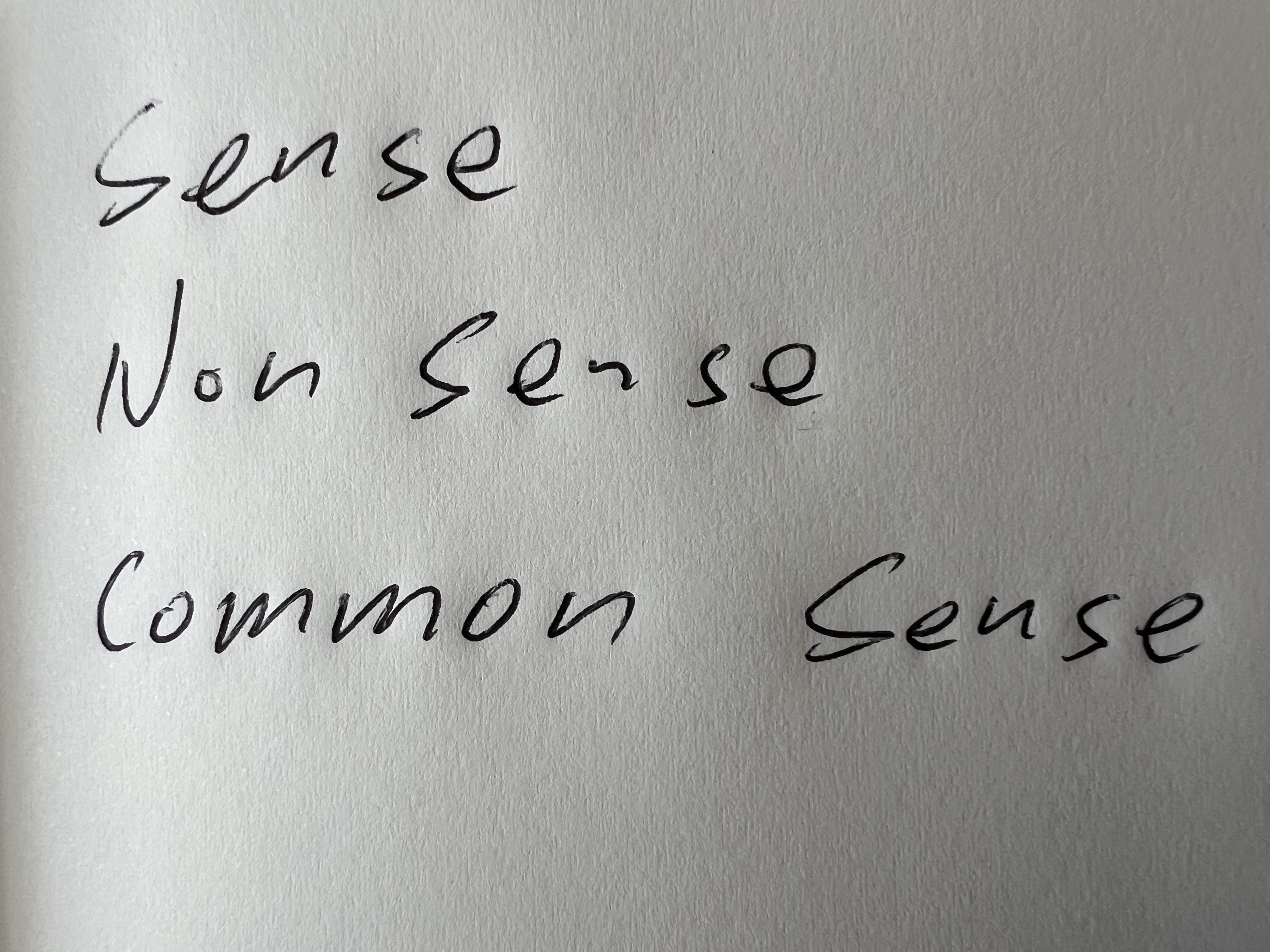
Gemma 4 31B: The image presents a deceptively simple linguistic progression: "Sense," "Non Sense," and "Common Sense." While these appear as mere vocabulary entries, they actually trace the complex evolution of human cognition, from the raw biological intake of the world to the social constructs we use to navigate reality.
The first word, "Sense," represents the foundational level of existence. It is the biological gateway—the sight, sound, touch, taste, and smell that anchor us to the physical plane. In this primary state, sense is purely reactive. It is the immediate recognition of heat, the vibration of a voice, or the hue of a sunset. Without this basic sensory apparatus, the human experience would be a void. Sense is the raw data of life, the essential bridge between the internal consciousness and the external universe.
The second entry, "Non Sense," introduces the concept of disruption and the breakdown of logic. By adding a prefix of negation, the image highlights the fragility of meaning. Nonsense occurs when the sensory data we receive no longer aligns with the patterns we expect, or when language is stripped of its intended purpose. However, nonsense is not merely a failure; it is often a creative catalyst. From the surrealist art movement to the whimsical poetry of Lewis Carroll, nonsense allows the mind to break free from the rigid constraints of utility. It is in the realm of the nonsensical that irony, humor, and abstract thought are born, proving that the absence of traditional "sense" can actually expand the boundaries of human imagination.
Finally, the progression reaches "Common Sense." If "sense" is biological and "nonsense" is disruptive, "common sense" is social. It is the shared set of assumptions and intuitive judgments that a community agrees upon to function efficiently. Unlike the first two terms, common sense is not innate or universal; it is learned and cultural. What is common sense to a sailor in a storm is nonsense to a city dweller. It represents the distillation of experience into a shorthand for survival and social harmony. It is the "common" ground upon which we build our interactions, allowing us to move through the world without having to re-evaluate every basic fact of existence from scratch.
Together, these three phrases map the trajectory of the human mind. We begin with the biological ability to perceive (Sense), we encounter the chaotic and the absurd (Non Sense), and we eventually synthesize these experiences into a shared framework of practical wisdom (Common Sense). The image serves as a reminder that our understanding of the world is a layered process, moving from the individual pulse of a nerve to the collective agreement of a society.
User prompt 2 of 7 - 9/3/2026, 11:42:55 AM: Related to AI.
Gemma 4 31B: The progression of "Sense," "Non Sense," and "Common Sense" takes on a profound new meaning when applied to the development of Artificial Intelligence. In the context of machine learning, these terms represent the three great hurdles of AI evolution: data acquisition, the "hallucination" problem, and the elusive quest for Artificial General Intelligence (AGI).
For an AI, "Sense" is equivalent to data ingestion. A large language model does not "sense" the world through biological organs, but through tokens, pixels, and vectors. This is the stage of pattern recognition. When an AI identifies a cat in a photo or predicts the next word in a sentence, it is exercising a digital version of sense. It is processing raw input and finding statistical correlations. However, this is a hollow form of perception; the AI knows the mathematical relationship between the word "apple" and the word "red," but it has no sensory experience of the taste or the scent. Its "sense" is a map of the world, but it has never visited the territory.
This gap between statistical correlation and true understanding leads directly to "Non Sense." In AI, nonsense manifests as hallucinations—moments where the model generates a confident but entirely factualy incorrect response. Because the AI operates on probability rather than truth, it can produce "nonsense" that looks perfectly logical on the surface. This occurs when the AI’s internal weights lean toward a plausible-sounding pattern that does not exist in reality. The "nonsense" of AI is a mirror of its own architecture: it is the result of a system that knows how to speak but does not know what it is talking about.
The final and most difficult peak is "Common Sense." In the field of AI, common sense is often referred to as the "knowledge representation" problem. For humans, common sense is the intuitive understanding that if you tip a glass of water, the floor will get wet. For an AI, this is not an intuitive truth but a piece of data that must be explicitly taught or inferred from millions of examples. The lack of "common sense" is what separates current narrow AI from true intelligence. While an AI can pass a bar exam or write code, it often fails at simple tasks that a five-year-old would find trivial because it lacks a grounded model of physical reality and social nuance.
Ultimately, the journey from Sense to Common Sense is the roadmap for the future of AI. We have mastered the "Sense" of big data and are learning to mitigate the "Non Sense" of hallucinations. The final frontier remains "Common Sense"—the ability for a machine to move beyond predicting the next token and begin understanding the fundamental, unwritten rules of the human world. Until then, AI remains a brilliant mimic: capable of processing the signals of sense and the chaos of nonsense, but still searching for the wisdom of common sense.
User prompt 3 of 7 - 9/3/2026, 11:44:10 AM: Don’t over use “Ultimately”, it sounds so AI generated.
Gemma 4 31B: The progression of "Sense," "Non Sense," and "Common Sense" takes on a profound new meaning when applied to the development of Artificial Intelligence. In the context of machine learning, these terms represent the three great hurdles of AI evolution: data acquisition, the "hallucination" problem, and the elusive quest for Artificial General Intelligence (AGI).
For an AI, "Sense" is equivalent to data ingestion. A large language model does not "sense" the world through biological organs, but through tokens, pixels, and vectors. This is the stage of pattern recognition. When an AI identifies a cat in a photo or predicts the next word in a sentence, it is exercising a digital version of sense. It is processing raw input and finding statistical correlations. However, this is a hollow form of perception; the AI knows the mathematical relationship between the word "apple" and the word "red," but it has no sensory experience of the taste or the scent. Its "sense" is a map of the world, but it has never visited the territory.
This gap between statistical correlation and true understanding leads directly to "Non Sense." In AI, nonsense manifests as hallucinations—moments where the model generates a confident but entirely factually incorrect response. Because the AI operates on probability rather than truth, it can produce "nonsense" that looks perfectly logical on the surface. This occurs when the AI’s internal weights lean toward a plausible-sounding pattern that does not exist in reality. The "nonsense" of AI is a mirror of its own architecture: it is the result of a system that knows how to speak but does not know what it is talking about.
The final and most difficult peak is "Common Sense." In the field of AI, common sense is often referred to as the "knowledge representation" problem. For humans, common sense is the intuitive understanding that if you tip a glass of water, the floor will get wet. For an AI, this is not an intuitive truth but a piece of data that must be explicitly taught or inferred from millions of examples. The lack of "common sense" is what separates current narrow AI from true intelligence. While an AI can pass a bar exam or write code, it often fails at simple tasks that a five-year-old would find trivial because it lacks a grounded model of physical reality and social nuance.
The journey from Sense to Common Sense is the current roadmap for the future of AI. We have mastered the "Sense" of big data and are learning to mitigate the "Non Sense" of hallucinations. The final frontier remains "Common Sense"—the ability for a machine to move beyond predicting the next token and begin understanding the fundamental, unwritten rules of the human world. Until then, AI remains a brilliant mimic: capable of processing the signals of sense and the chaos of nonsense, but still searching for the wisdom of common sense.
User prompt 4 of 7 - 9/3/2026, 11:44:53 AM: Remove AI slop and use common sense English.
Gemma 4 31B: If you apply those three words to AI, you're looking at the difference between a calculator and a conscious mind.
"Sense" for an AI is just data. It doesn't feel, smell, or see; it just processes patterns. When a model recognizes a face or predicts a word, it isn't "sensing" anything in the human way—it's just doing math on a massive scale. It has the map of human language, but it's never actually stepped outside into the world.
That gap is where "Non Sense" comes in. In AI, we call this hallucinating. Because the AI is just guessing the next most likely word based on probability, it can confidently tell you a lie that sounds perfectly reasonable. It produces nonsense because it doesn't actually know what "truth" is; it only knows what "likely" looks like.
The real wall, though, is "Common Sense." This is the hardest part to program. A human knows that if you put a book on a table and push the table, the book moves too. An AI doesn't "know" that unless it has read a thousand descriptions of tables and books. It lacks the basic, intuitive grasp of how the physical and social world works.
The goal of AI development is basically trying to move from the first word to the last. We've figured out the data (Sense) and we're trying to fix the glitches (Non Sense), but we're still a long way from a machine that actually has common sense.
User prompt 5 of 7 - 9/3/2026, 11:45:58 AM: Is the essay above nonsense?
Gemma 4 31B: No, it isn't nonsense. It's a logical argument that uses the three words from your image as a metaphor for how AI works.
It argues that AI is great at the first step (processing data), struggles with the second (making things up), and is currently failing at the third (understanding basic reality). It's a coherent way to explain why a chatbot can write a poem in seconds but might struggle to understand a simple physical joke.
User prompt 6 of 7 - 9/3/2026, 11:46:57 AM: So what is the joke I want to tell with this exercise?
Gemma 4 31B: The joke is the irony of the situation: you are asking an AI to use "common sense" to explain a picture about "common sense."
The punchline is that while I can write a sophisticated essay analyzing the concept of common sense, I don't actually possess it. I am just using "sense" (data patterns) to simulate an understanding of "common sense."
By pushing me to remove the "AI slop" and use "common sense English," you've highlighted the exact gap described in the essay: the difference between a machine that can mimic human language and a human who actually understands the world.
User prompt 7 of 7 - 9/3/2026, 11:48:43 AM: Now synthesize everything and make a plan for a Ph. D. Thesis in Philosophy, Psychology or Cognitive Science.
Gemma 4 31B: Since this exercise bridges the gap between linguistics, machine learning, and human intuition, the best fit would be Cognitive Science. This allows you to blend the philosophy of mind with the technical reality of AI.
Here is a thesis plan centered on the "Sense $\rightarrow$ Non Sense $\rightarrow$ Common Sense" framework.
Thesis Title: The Gap of Grounding: Analyzing the Transition from Statistical Correlation to Functional Common Sense in Large Language Models
1. Research Question
Can "Common Sense" be emergent from purely statistical "Sense" (data patterns), or does it require embodied experience (physical interaction with the world) to move beyond "Non Sense" (hallucinations)?
2. Theoretical Framework
The thesis would use the three-tier progression as a model for cognitive maturity:
- Tier 1: Sensory Processing (The Input Phase): Analyzing how LLMs treat tokens as a proxy for sensory experience.
- Tier 2: The Logic of the Absurd (The Error Phase): Studying hallucinations not as "bugs," but as the natural result of a system that has sense (patterns) but no grounding (truth).
- Tier 3: Heuristic Synthesis (The Common Sense Phase): Investigating whether "common sense" is just a very complex set of patterns or a separate cognitive faculty entirely.
3. Proposed Methodology
- Comparative Analysis: Create a battery of tests that distinguish between factual knowledge (which AI excels at) and common sense intuition (where AI fails). For example, "The Winograd Schema Challenge" where pronouns depend on world knowledge, not grammar.
- The "Nonsense" Audit: Analyze specific AI hallucinations to determine if the AI is following a "false logic" that reveals how it perceives the world differently than humans do.
- Cross-Disciplinary Mapping: Compare the way a human child acquires common sense (through trial, error, and physical touch) versus how an AI acquires it (through reading billions of words written by humans).
4. Potential Hypotheses
- The Embodiment Hypothesis: That "Common Sense" is impossible for a non-physical entity. The argument would be that you cannot have common sense about a world you have never touched.
- The Scaling Hypothesis: That if you provide enough "Sense" (data), "Common Sense" will eventually emerge as a statistical certainty.
5. Significance of the Work
This thesis would contribute to the debate on AGI (Artificial General Intelligence). Instead of just measuring if an AI can pass a test (like the Turing Test), it proposes a new metric for intelligence: the ability to navigate the "Non Sense" of the world using "Common Sense" rather than just probability.