Prudence in the AI age
This conversation was generated with Duck.ai (https://duck.ai) using Google's Gemma 4 31B Model. AI chats may display inaccurate or offensive information (see https://duckduckgo.com/duckai/privacy-terms for more info).
====================
User prompt 1 of 4 - 9/4/2026, 12:27:38 PM: Relate this to the AI fad. [Attached image 1]
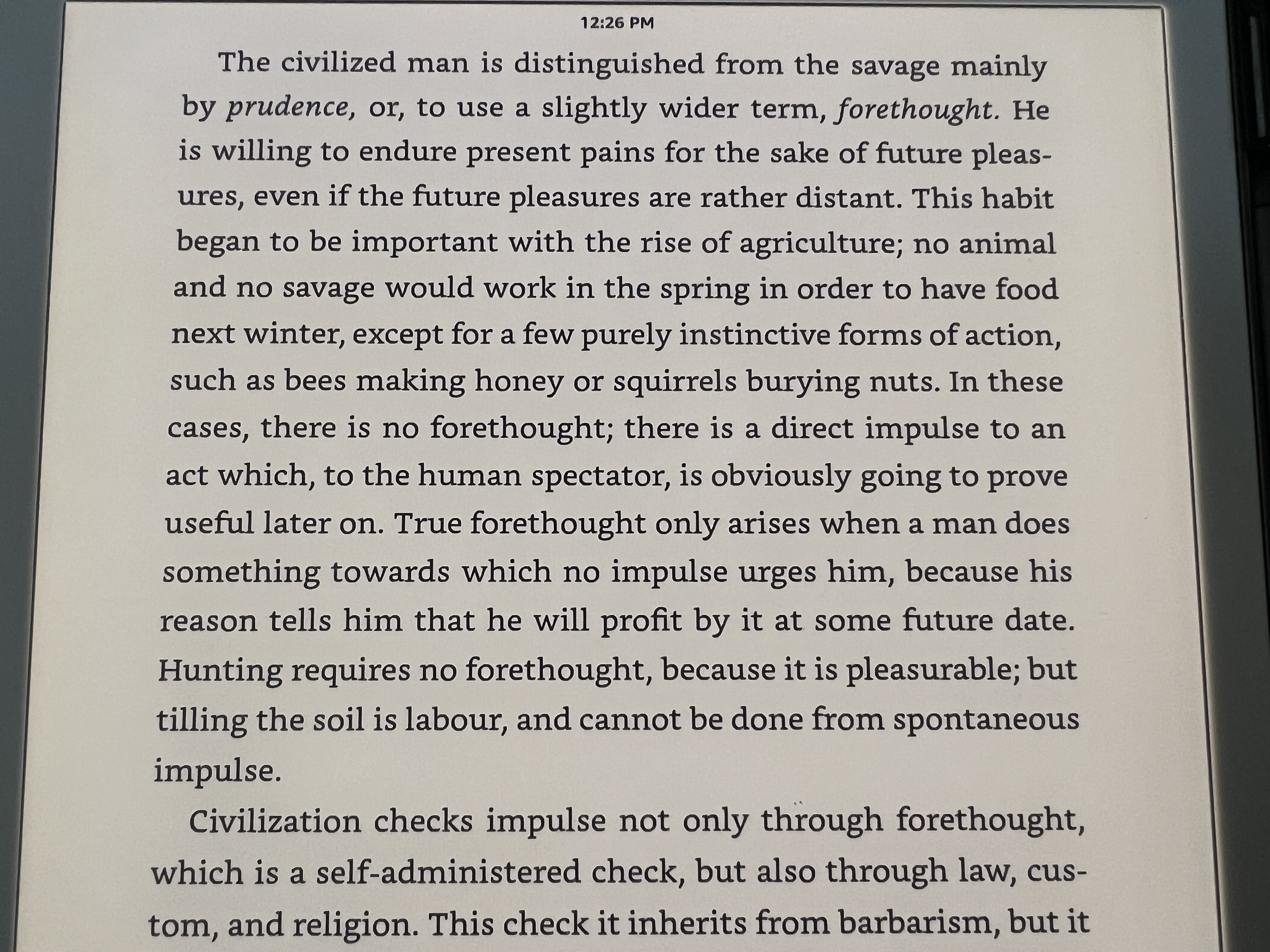
Gemma 4 31B: The text argues that civilization is defined by forethought—the ability to endure present labor or discomfort for a distant, reasoned reward, rather than acting on immediate impulse. This relates to the current AI "fad" through the tension between immediate gratification and long-term intellectual labor.
Generative AI often acts as a tool for the "spontaneous impulse." Where the text describes tilling the soil as labor that requires reason to overcome the lack of immediate pleasure, AI allows users to bypass the "present pains" of drafting, researching, or coding. By providing an instant result, AI removes the friction of the process. If the "civilized man" is distinguished by his willingness to endure the struggle of creation for a future goal, the heavy reliance on AI risks substituting that reasoned labor with a direct impulse to the finished product.
Furthermore, the passage distinguishes between instinct (like bees making honey) and true forethought (reasoning toward a future profit). Much of the current AI hype is driven by a similar instinctual drive for efficiency and optimization. The "fad" element often involves adopting these tools not because of a reasoned, long-term strategy for human advancement, but because of a spontaneous impulse to keep up with a trend or to reduce effort. In this light, the transition from doing the hard work of thinking to prompting a machine could be viewed as a shift away from the very "prudence" the author claims defines civilization.
User prompt 2 of 4 - 9/4/2026, 12:29:06 PM: Extend this thought with the sense of history and future.
Gemma 4 31B: Historically, human progress has been marked by the outsourcing of labor to tools, but the text suggests a critical distinction between outsourcing physical toil and outsourcing the cognitive "forethought" that governs it. The rise of agriculture was the first great shift; humans moved from the immediate impulse of hunting to the disciplined, long-term planning of farming. This required a fundamental rewiring of the human psyche to value the distant future over the present moment. Each subsequent historical leap—the Industrial Revolution, the Digital Age—further reduced the physical "pains" required to achieve "future pleasures," gradually pushing the boundary of where human effort ends and tool-assisted results begin.
We are now entering a phase where we are outsourcing not just the labor, but the reasoning process itself. If the agricultural revolution trained humans to endure boredom and hardship for a harvest, the AI era may be training humans to avoid the cognitive struggle entirely. The danger, viewed through the lens of this text, is a regression into a state of "spontaneous impulse." When the gap between a desire and its fulfillment shrinks to a few seconds of prompting, the mental muscle of prudence—the ability to plan, iterate, and suffer through a difficult problem—may atrophy.
Looking toward the future, this creates a paradox of civilization. We may reach a point of unprecedented material and intellectual abundance, yet find ourselves less "civilized" by the author's definition. If future generations no longer need to endure the "present pains" of learning a language, mastering a craft, or structuring a complex argument, they may lose the capacity for forethought. The future risk is not that AI will become "too smart," but that humans will become too reliant on the impulse of the immediate answer, effectively returning to a state of intellectual instinct where we act on the outputs of a machine without the reasoned, disciplined labor that historically built civilization.
User prompt 3 of 4 - 9/4/2026, 1:08:00 PM: How can we use AI prudently?
Gemma 4 31B: To use AI prudently, in the context of the provided text, one must consciously ensure that the tool enhances rather than replaces the act of forethought. Prudence requires using AI not to bypass the "present pains" of intellectual labor, but to strategically manage them.
One way to achieve this is by using AI as a scaffold rather than a substitute. Instead of asking an AI to produce a final result—which satisfies a spontaneous impulse—use it to challenge your own reasoning, generate counter-arguments, or organize a complex set of thoughts you have already labored over. By treating the AI as a collaborator in the "tilling of the soil" rather than a machine that magically produces the harvest, you maintain the cognitive discipline of reasoned effort.
Another approach is to intentionally preserve "friction" in your workflow. Prudence is developed through the struggle of overcoming resistance. You can practice this by committing to a "human-first" phase of any project: brainstorming, sketching, or drafting without digital assistance. By enduring the initial discomfort of a blank page, you exercise the mental faculty of forethought. Once the foundational reasoning is established, AI can then be used to refine or scale the work, ensuring that the human remains the architect of the long-term goal.
Finally, prudent usage involves a constant evaluation of the long-term cost of efficiency. Every time a task is automated, it is worth asking: "Is the skill I am skipping essential to my ability to think independently in the future?" Prudence is the ability to sacrifice a small amount of current speed for the sake of long-term competence. Using AI prudently means knowing when the "pain" of doing it yourself is actually the most valuable part of the process.
User prompt 4 of 4 - 9/4/2026, 1:09:14 PM: How about AI induced enthusiasm and burn out?
Gemma 4 31B: AI-induced enthusiasm and burnout can be viewed as two sides of the same "impulse" described in the text. The initial enthusiasm is often a form of spontaneous impulse—the excitement of a new tool that promises to eliminate labor and provide immediate rewards. This creates a "honeymoon phase" where the user feels a surge of productivity because the friction of work has vanished. However, because this enthusiasm is driven by the thrill of the result rather than the discipline of the process, it is inherently unsustainable.
Burnout occurs when the "future pleasures" promised by AI efficiency fail to materialize, or when the pace of the "instant result" becomes an unsustainable demand. When AI removes the natural pauses and struggles of work, it removes the rhythmic cycle of effort and reward. In a pre-AI world, the labor of "tilling the soil" provided a natural cadence to productivity; there was a beginning, a middle, and an end. AI collapses this timeline, creating an expectation of constant, high-speed output. When a human tries to keep pace with a machine's lack of fatigue, they enter a state of chronic stress.
This burnout is a crisis of prudence. The enthusiast ignores the long-term cost of their acceleration, trading their mental well-being for short-term gains in output. They operate on a "direct impulse" to produce more and faster, forgetting that human cognition—unlike a model—requires periods of stillness and "present pain" (rest and reflection) to remain healthy.
To avoid this, one must apply the "self-administered check" mentioned in the text. This means setting boundaries that intentionally reintroduce slowness into the work process. By consciously deciding when to disconnect from the AI's speed, a person reclaims their agency over their time. Prudence in the AI age is the ability to recognize that while the machine can work at infinite speed, the human mind requires a slower, more reasoned pace to avoid exhaustion and maintain meaning.