Degenerate learning
This conversation was generated with Duck.ai (https://duck.ai) using Google's Gemma 4 31B Model. AI chats may display inaccurate or offensive information (see https://duckduckgo.com/duckai/privacy-terms for more info).
====================
User prompt 1 of 3 - 9/8/2026, 8:30:11 AM:
[Attached image 1]
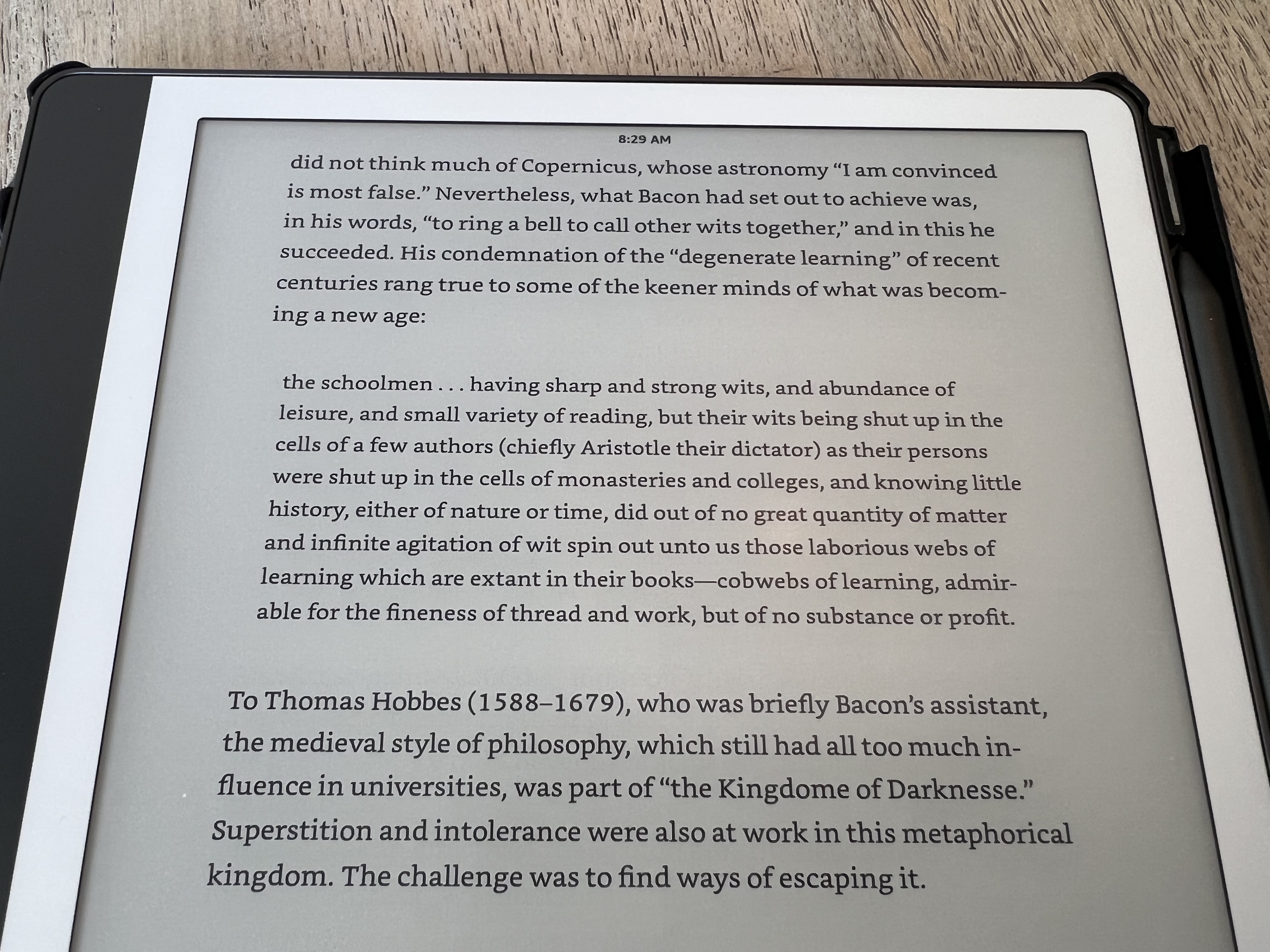
Gemma 4 31B: The text in the image discusses Francis Bacon's views on knowledge and the "degenerate learning" of his time. It mentions that Bacon was not particularly impressed with Copernicus, stating his astronomy was "most false."
The second paragraph describes the "schoolmen" of the era, noting that while they possessed sharp wits and leisure, their learning was limited because they were confined to the "cells of a few authors" (specifically citing Aristotle as their "dictator") and the isolation of monasteries and colleges. Bacon critiqued their work as "laborious webs of learning" that were intricate in detail but lacked "substance or profit."
The final section connects this to Thomas Hobbes (1588–1679), a brief assistant to Bacon, noting that the medieval style of philosophy prevalent in universities was part of what Bacon called "the Kingdome of Darknesse," a metaphorical realm defined by superstition and intolerance.
User prompt 2 of 3 - 9/8/2026, 8:31:35 AM: How do we avoid degenerate learning in the age of automated synthesis?
Gemma 4 31B: Avoiding degenerate learning in an era of automated synthesis requires shifting the focus from the acquisition of answers to the mastery of inquiry. When AI can synthesize vast amounts of information instantly, the risk is a new form of "scholasticism"—where we become experts in prompting a machine rather than understanding the underlying mechanisms of the subject.
To counter this, one can employ several intellectual strategies:
Prioritize First-Principles Thinking Automated synthesis often provides the "what" and the "how" without the "why." To avoid superficiality, break concepts down to their most basic truths and rebuild them from the ground up. Instead of accepting a synthesized summary of a theory, trace the logic back to its axioms. If you cannot derive the conclusion yourself, you have not learned the material; you have only encountered a report of it.
Embrace "Productive Struggle" Learning is a biological process of encoding information through effort. Automated synthesis removes the friction of research—the act of searching through a library, encountering contradictory sources, and synthesizing a conclusion. This friction is where critical thinking is developed. Intentionally introduce "analog" hurdles, such as writing long-form essays by hand or engaging in live Socratic debates, to ensure the brain is doing the heavy lifting rather than the processor.
Cultivate Adversarial Reading AI synthesis tends toward the "average" or the most probable consensus, which can create an intellectual echo chamber. Avoid this by seeking out "edge cases"—the dissenting opinions, the fringe theories, and the primary sources that the AI might have smoothed over in its summary. Compare the synthesized version with the original text to identify what was lost in translation; the gap between the synthesis and the source is often where the most nuanced learning occurs.
Shift from Consumption to Production The danger of automated synthesis is that it makes the user a passive consumer of highly polished outputs. The antidote is active production. Use AI as a scaffold, not a final product. For every synthesized summary you receive, challenge yourself to apply that knowledge to a new, unsolved problem or to teach the concept to someone else. True mastery is proven when you can manipulate the information in a way the AI cannot predict.
User prompt 3 of 3 - 9/8/2026, 8:32:25 AM: What would Bacon do in this era?
Gemma 4 31B: Based on his philosophy of the Novum Organum and his lifelong crusade against "degenerate learning," Francis Bacon would likely view modern AI with a mixture of intense fascination and profound suspicion. He would see automated synthesis as the ultimate "Idol of the Market"—a tool that risks amplifying linguistic confusion and intellectual laziness on a global scale.
Here is how Bacon would likely approach the era of AI:
He would treat AI as a "Tool," not an "Oracle" Bacon believed that the goal of science was the "relief of man's estate" through practical application. He would likely embrace AI as a powerful instrument for data organization and pattern recognition—essentially a high-speed version of his own dream for a universal database of human knowledge. However, he would be horrified if people treated AI as a source of truth. To Bacon, truth is not found in the synthesis of existing opinions, but in the rigorous interrogation of nature.
He would warn against the "Idols of the Theatre" Bacon identified "Idols of the Theatre" as errors arising from blind faith in philosophical systems or dogmas. He would likely categorize LLMs as a new kind of "Theatre"—systems that produce authoritative-sounding prose that can be entirely untethered from physical reality (hallucinations). He would warn that relying on AI synthesis is simply replacing the "dictatorship of Aristotle" with the "dictatorship of the Algorithm," substituting one set of invisible biases for another.
He would demand an "Inductive" approach to AI Bacon championed induction—moving from specific, observed facts to general laws. He would likely argue that we are currently doing the opposite: using AI to move from general probabilistic patterns to specific answers. He would advocate for a methodology where AI is used to suggest hypotheses, but those hypotheses must be strictly validated through empirical experimentation and physical evidence before being accepted.
He would launch a new "Great Instauration" Bacon believed that human knowledge needed a total reset to move past the stagnation of the Middle Ages. Seeing the potential for AI to create a "sea of superficiality," he would likely call for a new educational revolution. He would argue that since the "laborious web" of synthesis is now automated, the human mind must be freed to pursue higher-order creativity, ethical judgment, and the direct observation of the natural world.
In short, Bacon would use the AI to organize the data, but he would trust only the experiment. He would remind us that while a machine can synthesize the words of a thousand books, it has never once smelled a flower or watched a pendulum swing.