Scaling curve of resource utilization
This conversation was generated with Duck.ai (https://duck.ai) using Google's Gemma 4 31B Model. AI chats may display inaccurate or offensive information (see https://duckduckgo.com/duckai/privacy-terms for more info).
====================
User prompt 1 of 5 - 9/9/2026, 7:53:09 AM:
[Attached image 1][Attached image 2]

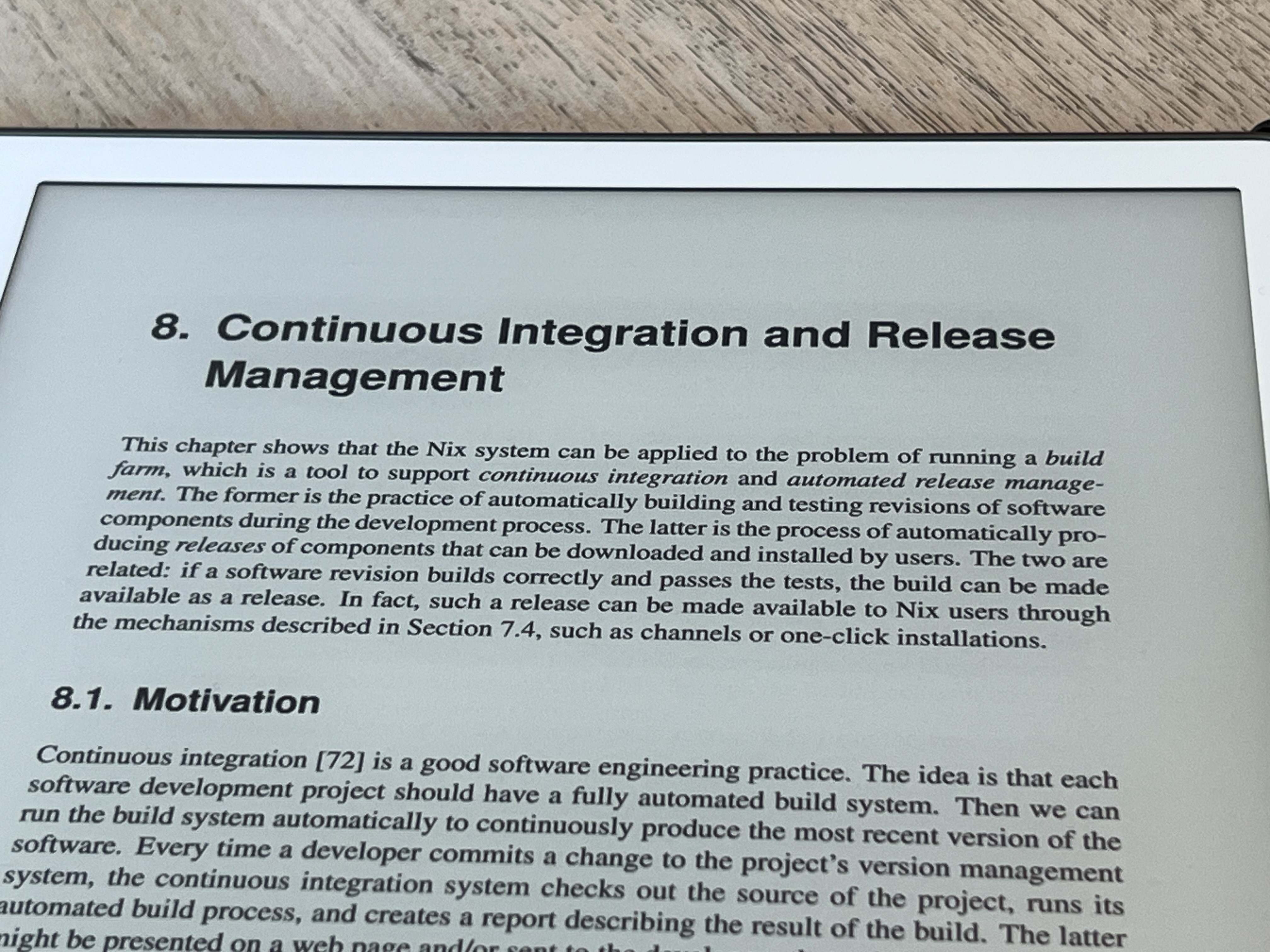
Gemma 4 31B: The text on the screen discusses the application of the Nix system to continuous integration (CI) and release management. It explains that a build farm can be used to automate the building and testing of software revisions (CI) and the subsequent production of downloadable components for users (release management). The "Motivation" section describes CI as a software engineering practice where a fully automated build system continuously produces the most recent version of the software, triggering a build and generating a report every time a developer commits a change to the version management system.
User prompt 2 of 5 - 9/9/2026, 7:55:15 AM: How do we scale CI and release management in the age of super large scale data and continuous data flows?
Gemma 4 31B: Scaling continuous integration (CI) and release management for massive data volumes and constant data flows requires moving away from traditional "build-and-deploy" cycles toward a streaming and decoupled architecture.
One of the primary shifts is the move toward data-centric CI/CD, where the pipeline doesn't just test the code, but also validates the data schemas and quality of the incoming data flows. In large-scale environments, this often involves implementing "Data Contracts" between producers and consumers. These contracts act as a formal agreement on the data's structure and quality, allowing the CI system to automatically reject changes to a data producer's code if it would break downstream consumers, preventing "data downtime" in a production flow.
From an infrastructure perspective, scaling is achieved through extreme parallelism and ephemeral environments. Rather than a few large build servers, modern systems use container orchestration (like Kubernetes) to spin up thousands of isolated, short-lived environments that run tests in parallel. To handle the "super large scale" aspect, teams often employ "test impact analysis," which uses dependency graphing to run only the subset of tests affected by a specific code change, rather than the entire suite, which would be computationally prohibitive at scale.
For release management, the risk of a "big bang" deployment is too high with continuous data flows. Instead, companies use progressive delivery techniques:
- Canary Releases: Routing a small percentage of the data flow to a new version of the service to monitor for errors before a full rollout.
- Feature Flags: Decoupling deployment (moving code to production) from release (turning the feature on for users), allowing for instant rollbacks without needing to redeploy code.
- Blue-Green Deployment: Maintaining two identical production environments to ensure zero-downtime handovers.
Finally, the "continuous" nature of the data flow necessitates a shift toward observability and automated remediation. At this scale, manual monitoring is impossible, so systems are designed with "automated rollbacks" triggered by SLIs (Service Level Indicators). If a new release causes a spike in latency or error rates in the data stream, the system automatically reverts to the previous stable version without human intervention.
User prompt 3 of 5 - 9/9/2026, 7:57:49 AM: Can Nix adapt to this new environment?
Gemma 4 31B: Nix is uniquely positioned to adapt to large-scale, data-intensive environments because its core philosophy—functional purity and immutability—directly addresses the biggest pain points of scaling CI/CD: non-determinism and environment drift.
In a super large-scale environment, Nix provides several critical advantages:
Elimination of "It Works on My Machine" Traditional CI often fails because the build environment differs slightly from the production environment. Because Nix stores every dependency in a unique path based on a cryptographic hash of its inputs, the environment is identical across every stage of the pipeline. This means a build that passes in CI is guaranteed to be the exact same binary in production, eliminating the "drift" that often causes catastrophic failures during large-scale releases.
Efficient Scaling via Binary Caching Scaling CI for massive projects usually leads to "build bottlenecks" where developers wait hours for tests. Nix solves this through its binary cache. Since a Nix derivation is a pure function, if the inputs haven't changed, the output won't either. If one node in a global build farm has already built a specific dependency, every other node can simply download the pre-compiled binary. This transforms the CI process from a computational problem into a distribution problem, drastically reducing build times.
Safe Progressive Delivery Nix makes atomic rollbacks trivial. Because it doesn't overwrite files but instead creates new paths for new versions, switching a production service from version A to version B is simply a matter of updating a symlink. If a data flow begins to fail during a canary release, Nix can revert the entire system state to the previous known-good configuration in milliseconds, as the previous version's dependencies remain intact on the disk.
Managing Complex Data Toolchains Large-scale data flows often require a fragile mix of system libraries, Python versions, and C++ binaries. Managing these with traditional tools (like Docker alone) can lead to bloated images and slow startup times. Nix allows for "fine-grained" environment management, providing only the exact libraries needed for a specific data processing task without the overhead of a full OS image, which improves the cold-start time of ephemeral CI runners.
The Gap: The "Data" in Data-Centric CI Where Nix needs to adapt further is in the distinction between code and state. Nix is a master of managing immutable inputs and outputs. However, "continuous data flows" involve mutable state and evolving schemas. Nix cannot "hash" a live Kafka stream or a multi-petabyte database.
To fully adapt, Nix is typically used as the foundation (providing the reliable, reproducible engine) while being paired with data-specific orchestration tools (like Great Expectations for data validation or ArgoCD for Kubernetes delivery) to handle the fluid nature of the data itself.
User prompt 4 of 5 - 9/9/2026, 8:19:24 AM: How can we improve resource efficiency in the age of scaling? Binary caching only shifted the burden from computing to storage and network. This is not sustainable.
Gemma 4 31B: To achieve true resource efficiency beyond just shifting the burden from CPU to Disk/Network, the focus must move from redundancy (caching everything) to intelligence (calculating only what is necessary) and leaner execution.
Here are the primary strategies for sustainable scaling:
1. Content-Addressable Storage (CAS) and Deduplication Binary caching is wasteful if it stores multiple copies of the same object under different names. True efficiency requires a content-addressable system where the storage key is the hash of the content itself, not the derivation. By using a global deduplication layer, if ten different versions of a project use the same version of a heavy library (like PyTorch), that library is stored exactly once on the physical disk, regardless of how many "packages" refer to it.
2. Fine-Grained Dependency Graphing (Incrementalism) Most CI pipelines are too coarse; they rebuild an entire module when a single comment is changed. Efficiency is found in "extreme incrementalism." By breaking the build graph into the smallest possible units, the system can determine the exact "blast radius" of a change. Instead of rebuilding a container, the system should only rebuild the specific object file or layer that changed. This minimizes the amount of data that needs to be computed, hashed, and transmitted over the network.
3. Right-Sizing via "Thin" Environments The industry trend of "everything in a container" has led to massive resource waste (e.g., 1GB images to run a 10MB binary). Moving toward "distroless" images or Nix-style store paths removes the overhead of a guest OS (shell, package managers, coreutils) from every single CI runner. When you remove the "OS tax" from 10,000 concurrent runners, the savings in RAM and disk I/O are massive.
4. Intelligent Scheduling and "Warm" Runners The network cost of pulling binaries from a cache is often higher than the cost of local computation if the data is already nearby. Resource efficiency requires "locality-aware scheduling." The orchestrator should route a build job to a runner that already has the required layers in its local cache. This reduces the "North-South" network traffic (Runner $\leftrightarrow$ Cache) and maximizes "East-West" efficiency (Local Disk).
5. Moving Logic "Left" (Static Analysis vs. Runtime Testing) The most efficient resource is the one you never use. Shifting from expensive integration tests (which require spinning up databases and networks) to formal verification and advanced static analysis reduces the reliance on heavy CI runs. If a compiler or a type-system can mathematically prove a change won't break a data contract, you can skip the expensive runtime test entirely.
6. Adaptive Resource Allocation Most CI jobs are allocated a "standard" amount of CPU and RAM (e.g., 2 vCPU, 4GB RAM), but they rarely use it all, leading to massive "slack" in the cluster. Implementing predictive autoscaling—where the system analyzes the history of a specific build target to allocate exactly the resources it needs—can increase cluster density and reduce the physical hardware footprint.
User prompt 5 of 5 - 9/9/2026, 8:20:31 AM: How can we change the scaling of resource consumption?
Gemma 4 31B: To fundamentally change the scaling curve of resource consumption—meaning moving from a linear or exponential growth of costs to a sub-linear or logarithmic one—you have to stop treating the build and release process as a sequence of events and start treating it as a continuous state.
Currently, most systems scale by adding more "brute force" (more nodes, more cache, more bandwidth). To change the trajectory, you must implement the following structural shifts:
1. From "Rebuild" to "Transform" (The Delta Shift) The current paradigm is: Change $\rightarrow$ Build $\rightarrow$ Test $\rightarrow$ Deploy. This scales linearly with the size of the codebase. The efficient paradigm is: Change $\rightarrow$ Calculate Delta $\rightarrow$ Apply Transform $\rightarrow$ Validate. Instead of recreating the environment, the system should treat the existing production state as the baseline and only apply the "diff." This shifts the resource cost from being proportional to the total size of the system to being proportional only to the size of the change.
2. Decoupling the Control Plane from the Data Plane In many CI systems, the "orchestrator" manages both the logic (what to build) and the movement of the bits (shipping the binary). As you scale, the orchestrator becomes a bottleneck. By decoupling them—using a lightweight control plane to signal what is needed and a peer-to-peer (P2P) data plane (like BitTorrent or IPFS) for the binaries—you eliminate the central cache bottleneck. The more runners you add, the more bandwidth you have available for distribution, turning the scaling burden into a scaling asset.
3. Virtualizing the Environment (Lazy Loading) Instead of downloading a 2GB environment before a test can start, move toward lazy loading (e.g., using FUSE or remote snapshots). In this model, the runner starts instantly, and the system only fetches the specific blocks of data from the cache the moment the CPU actually attempts to read them. Most tests only touch a fraction of their environment; lazy loading ensures you never spend network or disk resources on data that is never executed.
4. Shifting from "Time-Based" to "Event-Based" Validation Standard scaling involves running "nightly builds" or "periodic sweeps." This is inherently wasteful. Changing the scaling requires a move to reactive validation. By using a graph-based trigger system, the environment only consumes resources when a specific dependency in the graph changes. If a change is made to a documentation folder, the system should be "smart" enough to know that zero compute resources are required for the binary pipeline.
5. Hardware-Software Co-design (Specialized Runners) General-purpose CPUs are inefficient for the specific tasks of CI (which are heavy on I/O, hashing, and serialization). Changing the consumption curve involves moving these specific workloads to specialized hardware. For example, offloading the cryptographic hashing of Nix store paths or the compression of binary caches to an FPGA or a dedicated SmartNIC (Network Interface Card) can reduce the CPU load by orders of magnitude.
Summary of the Shift
| Current Scaling (Linear/Exponential) | New Scaling (Sub-linear/Logarithmic) |
|---|---|
| Proportional to System Size | Proportional to Change Size |
| Centralized Cache (Bottleneck) | Distributed P2P Mesh (Asset) |
| Eager Loading (Fetch all) | Lazy Loading (Fetch on-demand) |
| Periodic/Scheduled Execution | Event-Driven/Reactive Execution |
| General Purpose Compute | Specialized I/O Acceleration |