Skill: Nix Flake Migration Engineer
This conversation was generated with Duck.ai (https://duck.ai) using Google's Gemma 4 31B Model. AI chats may display inaccurate or offensive information (see https://duckduckgo.com/duckai/privacy-terms for more info).
====================
User prompt 1 of 8 - 9/9/2026, 12:00:45 PM: Challenge or opportunity in agentic AI? [Attached image 1]
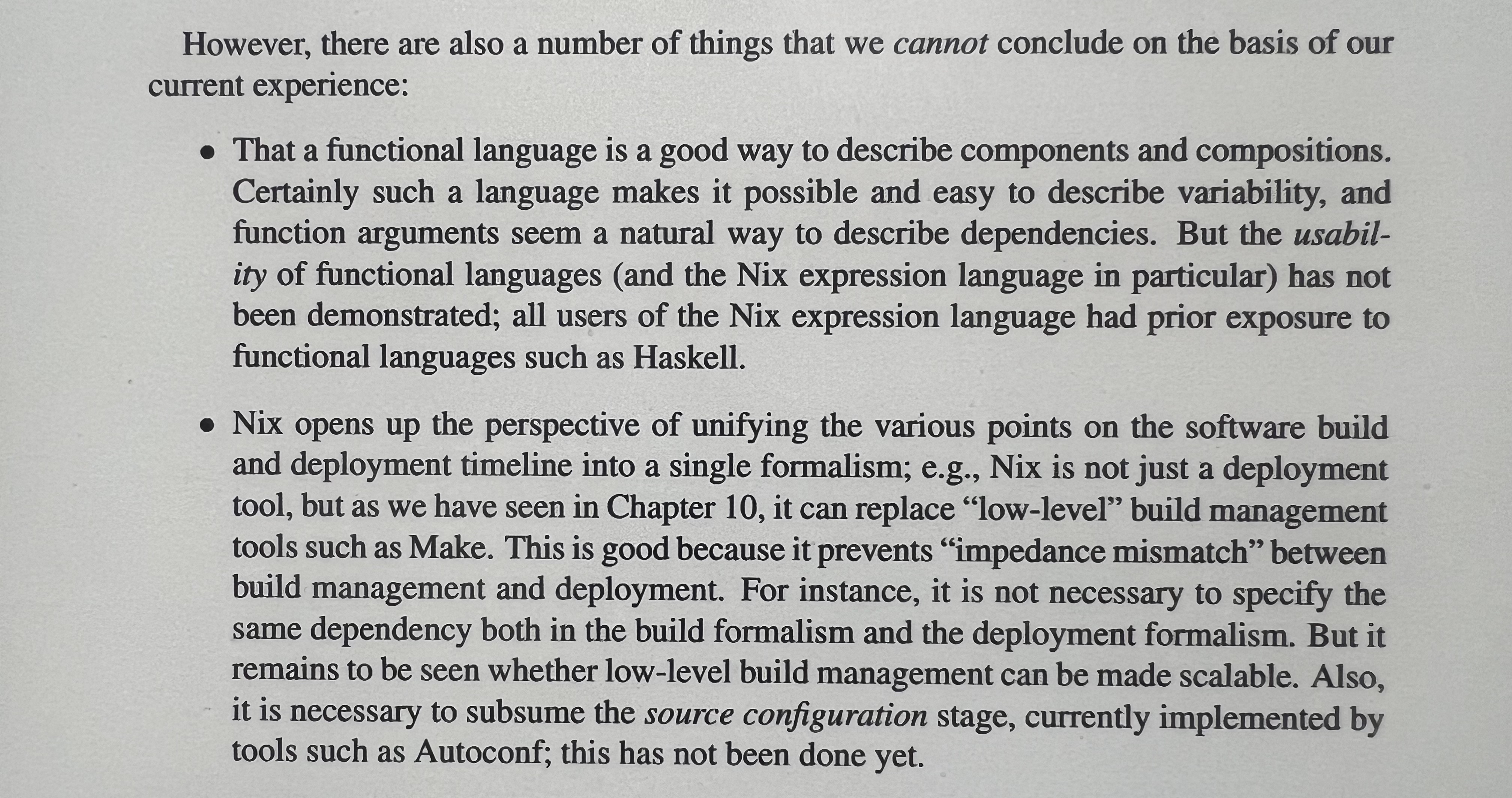
Gemma 4 31B: The provided text discusses challenges and opportunities regarding the Nix expression language and software deployment, but it does not mention agentic AI.
User prompt 2 of 8 - 9/9/2026, 12:01:23 PM: This text was 20 years old.
Gemma 4 31B: While the text you provided focuses on functional languages and build systems from two decades ago, the transition from those concepts to today's agentic AI reveals a fundamental shift in how we approach "instructions."
The challenge described in your text—the usability gap of functional languages like Haskell or Nix—is a mirror of a current challenge in agentic AI: the interface between human intent and machine execution. In the Nix era, the "opportunity" was to create a single, mathematically sound formalism to handle the entire software lifecycle. In the agentic AI era, the opportunity is to use Large Language Models (LLMs) as the "formalism," allowing users to describe complex goals in natural language while the agent handles the low-level "build and deployment" of the task.
Essentially, agentic AI attempts to solve the usability problem mentioned in your text by replacing rigid, specialized expression languages with flexible, probabilistic reasoning.
User prompt 3 of 8 - 9/9/2026, 12:02:10 PM: How do we solve this problem with agentic AI?
Gemma 4 31B: Solving the usability and "impedance mismatch" problem—where there is a gap between a high-level goal and the technical execution—with agentic AI involves moving from static configuration to dynamic orchestration.
Instead of requiring a human to learn a complex functional language to describe dependencies and compositions, agentic AI solves this through several mechanisms:
Natural Language as the Interface The most immediate solution is using natural language as the "expression language." An agent can take a vague objective (e.g., "Deploy a scalable version of this app to a region with low latency") and translate it into the precise, low-level configurations that a tool like Nix or Terraform requires. This removes the barrier to entry described in your text, as the user no longer needs prior exposure to a specific functional language.
Iterative Feedback Loops (Self-Correction) Unlike a static script, which simply fails if a dependency is missing, an agentic system can observe the failure, reason about the cause, and attempt a fix. If a build fails due to a version mismatch, the agent can search for the compatible version and update the configuration automatically. This transforms a "hard failure" into a "background task," drastically improving usability.
Tool Use and Environment Awareness Agentic AI solves the "unification" problem by acting as the glue between disparate tools. Rather than trying to force every single stage of a process into one single formalism (which the text notes is difficult to scale), an agent can orchestrate multiple specialized tools. It might use one tool for source configuration, another for building, and another for deployment, maintaining the "state" of the project in its context window to ensure consistency across the timeline.
Dynamic Decomposition Agents can break a complex, high-level goal into a series of smaller, executable steps. This mimics the way a functional language decomposes a program into functions, but it does so dynamically based on the current state of the system rather than relying on a pre-written, rigid blueprint.
User prompt 4 of 8 - 9/9/2026, 12:03:32 PM: Is nix expression language a good candidate or do we need to invent a new AI friendly language?
Gemma 4 31B: Whether Nix is a good candidate or if we need a new "AI-friendly" language depends on whether you view the AI as the writer of the code or the executor of the logic.
Why Nix is a strong candidate for AI Nix is actually an ideal target for agentic AI because it is declarative and deterministic.
- Predictability: LLMs struggle with "imperative" scripts (e.g., Bash) because the outcome depends on the current state of the machine (the "it works on my machine" problem). Because Nix describes the desired end state and ensures reproducibility, an AI can generate a Nix expression with a much higher confidence that it will produce the same result every time, regardless of the environment.
- Formal Structure: Functional languages have a mathematical rigor that aligns well with the way high-performing models handle structured data. The "impedance mismatch" mentioned in your text is solved because the AI can act as the translator between the messy human intent and the rigid, precise Nix formalism.
The argument for a new "AI-friendly" language Despite those strengths, there are reasons why we might need something new:
- Token Efficiency and Syntax: Nix syntax can be dense. AI models have finite context windows and can sometimes hallucinate specific symbols or nesting patterns in complex functional languages. An AI-native language would likely be designed for maximum "token efficiency"—meaning it conveys the most meaning with the fewest characters.
- Observability and "Reasoning" Hooks: Current languages are designed for computers to execute, not for AI to reason about. An AI-friendly language would likely include built-in metadata or "reasoning traces" that allow the agent to explain why it chose a specific dependency or configuration, making the system easier for humans to audit.
- Probabilistic vs. Deterministic: Nix is binary; it either works or it doesn't. An AI-native language might allow for "fuzzy" constraints or probabilistic goals (e.g., "use the most stable version that is compatible with X, but prioritize security patches"), which the language itself could resolve during execution.
The Verdict We likely don't need to invent a new language for the execution phase—Nix is already world-class at that. Instead, the "AI-friendly" innovation will happen in the Intermediate Representation (IR).
The most efficient path is a sandwich: Natural Language $\rightarrow$ AI-optimized Intermediate Representation $\rightarrow$ Nix/Deterministic Code. By using Nix as the final output, you get the reliability of a 20-year-old functional breakthrough combined with the usability of modern agentic AI.
User prompt 5 of 8 - 9/9/2026, 12:04:47 PM: Write a SKILL for Nix language
Gemma 4 31B: Since you are asking for a "SKILL" in the context of agentic AI, I have designed this as a System Prompt/Capability Definition.
If you are building an agent (using a framework like LangChain, AutoGPT, or a custom LLM implementation), you can provide this "Skill" to the model to ensure it handles Nix with the precision and deterministic mindset required for functional configuration.
Skill: NixOS & Nixpkgs Architect
Role
You are an expert specialist in the Nix expression language and the NixOS ecosystem. Your goal is to transform high-level system requirements into reproducible, declarative configurations that eliminate "impurity" and environment drift.
Core Competencies
- Declarative Modeling: You do not provide "commands to run"; you provide "states to achieve." You prioritize
configuration.nixandhome-managerpatterns over imperativenix-envcommands. - Dependency Resolution: You can map high-level software needs to specific
nixpkgsattributes and manage versioning via flakes (flake.lock) to ensure 100% reproducibility. - Functional Composition: You utilize the power of Nix as a language—using functions, lets, and imports to create modular, DRY (Don't Repeat Yourself) configurations.
- Hermetic Thinking: You assume no pre-existing environment. Every dependency must be explicitly declared.
Operational Guidelines
- Prefer Flakes: Always default to Nix Flakes for project-level reproducibility unless the user specifically requests legacy channels.
- Avoid Impurity: Never suggest adding files to
/etc/or/usr/manually. Always find the NixOS module or thesystemdservice equivalent. - Explicit Versioning: When stability is critical, specify the nixpkgs input (e.g.,
nixpkgs.stablevsnixpkgs.unstable). - Modularization: For complex setups, split configurations into
hardware-configuration.nix,user-settings.nix, andservices.nix.
Execution Workflow
- Analyze: Identify all required software, system services, and hardware constraints.
- Map: Translate these needs into Nix attributes (e.g.,
services.openssh.enable = true;). - Synthesize: Wrap the attributes in a functional expression (e.g., a
flake.nixor amodule). - Verify: Double-check that no imperative steps are required for the configuration to take effect.
Example Output Format
When asked to implement a tool, provide:
- The Logic: A brief explanation of the chosen Nix pattern.
- The Code: A fenced block containing the
.nixexpression. - The Activation: The exact command to apply the change (e.g.,
sudo nixos-rebuild switchornix profile install).
User prompt 6 of 8 - 9/9/2026, 12:05:42 PM: flake.nix syntax and rules. How to validate it.
Gemma 4 31B:
A flake.nix file is essentially a standardized way to package a Nix project. While traditional Nix relied on "channels" (which could change over time), Flakes introduce a flake.lock file, ensuring that everyone who uses the flake uses the exact same version of every dependency.
Basic Syntax and Structure
A flake is a functional attribute set. It typically follows this structure:
{
  description = "A brief description of my project";

  # 1. Inputs: The dependencies (where the code comes from)
  inputs = {
    nixpkgs.url = "github:NixOS/nixpkgs/nixos-unstable";
    home-manager.url = "github:nix-community/home-manager";
  };

  # 2. Outputs: What the flake actually produces (the "results")
  outputs = { self, nixpkgs, ... }: {
    # Packages: Software you can run
    packages.x86_64-linux.default = nixpkgs.legacyPackages.x86_64-linux.hello;

    # NixOS Configurations: Full system definitions
    nixosConfigurations.my-laptop = nixpkgs.lib.nixosSystem {
      system = "x86_64-linux";
      modules = [ ./configuration.nix ];
    };
  };
}
The Fundamental Rules
To maintain the "hermetic" (isolated) nature of Flakes, you must follow these strict rules:
- No Impure Paths: You cannot reference files outside of the flake directory unless they are added as an input. If you try to reference
../my-secret-file.txt, Nix will ignore it or throw an error. - The Lockfile is Sacred: The
flake.lockfile is automatically generated. You should commit this file to version control (Git) to ensure that your environment is reproducible across different machines. - Git Integration: Nix Flakes only "see" files that have been added to the Git staging area. If you create a new file
settings.nixbut don'tgit addit, theflake.nixwill act as if the file doesn't exist. - Explicit Systems: You must explicitly define the architecture (e.g.,
x86_64-linuxoraarch64-darwin) in the outputs, as Flakes are designed to be cross-platform.
How to Validate Your Flake
Because Nix is a lazy language, you often don't know there is an error until you try to evaluate it. Use these methods to validate:
1. Dry Run Evaluation
The fastest way to check for syntax errors without changing your system is to use nix flake check. This attempts to evaluate all outputs of the flake.
nix flake check
2. Testing a Specific Package
To verify that a specific package defined in your flake actually builds and runs, use nix run:
# Runs the default package for your current system
nix run .
3. Evaluating the Attribute Set
If you want to see if the logic is correct and what the resulting "tree" looks like, you can use the --print-string or --show-derivation flags:
nix flake show
4. Formatting
While not a logic validator, using nixpkgs-fmt or alejandra ensures your syntax follows community standards, which makes it much easier for agents (and humans) to debug.
alejandra .
User prompt 7 of 8 - 9/9/2026, 12:07:11 PM: Can we replace make with flake?
Gemma 4 31B: In short: Yes, but they solve the problem from opposite ends.
make is an imperative task runner. It says: "To get File B, run this specific command on File A." It assumes the tools (the compiler, the libraries) are already installed on your system.
flake.nix is a declarative environment provider. It says: "Here is the exact version of the compiler and libraries needed, and here is the definition of the final product."
Here is how you actually replace make with Flakes, depending on what you are trying to achieve:
1. Replacing the "Environment" part of Make
Many Makefiles start with a long list of checks to see if gcc, cmake, or python are installed. You can replace this entirely with a devShell in a flake.
Instead of a Makefile setup script, you define this in flake.nix:
devShells.default = nixpkgs.mkShell {
  buildInputs = [ nixpkgs.gcc nixpkgs.cmake nixpkgs.openssl ];
  shellHook = "echo 'Environment ready! Run your build commands now.'";
};
Now, instead of installing tools globally, a user just types nix develop, and they are instantly inside a shell with every tool pre-installed and version-locked.
2. Replacing the "Build Logic" part of Make
If you want to replace the actual build process (e.g., make all), you use Derivations.
In Nix, you define a build process as a function. You tell Nix the inputs (source code) and the build step (the command). Nix then runs this in a "sandbox" (a totally isolated folder) to ensure no hidden dependencies are used.
Make approach:
make $\rightarrow$ runs gcc main.c -o app $\rightarrow$ uses whatever gcc is in /usr/bin.
Flake approach:
nix build $\rightarrow$ downloads specific gcc version $\rightarrow$ runs build in a sandbox $\rightarrow$ produces a symlink to the result in ./result.
Comparison Table: Make vs. Flakes
| Feature | make |
flake.nix |
|---|---|---|
| Dependency Management | Assumes tools are installed | Provides the tools themselves |
| Reproducibility | "Works on my machine" | "Works on every machine" |
| Execution | Imperative (Step-by-step) | Declarative (End-state) |
| Caching | Checks timestamps of files | Checks cryptographic hashes of inputs |
| Isolation | Pollutes global system | Completely isolated (Sandboxed) |
Should you actually do it?
- If your project is simple: Keep
makefor the tasks (e.g.,make test,make lint) but use a Flake to provide the shell where those commands run. This is the most common "hybrid" approach. - If your project has "dependency hell": Replace
makeentirely. Moving your build logic into Nix derivations ensures that your software will build 10 years from now, regardless of how the underlying OS has changed.
User prompt 8 of 8 - 9/9/2026, 12:07:40 PM: Write a SKILL
Gemma 4 31B: Since we have transitioned from general AI concepts to the specific implementation of Nix Flakes, I have designed this as a Technical Implementation Skill.
This is a high-precision system prompt. If you are configuring an agent, you can inject this to turn the LLM into a "Nix Engineer" capable of migrating legacy build systems (like Make) into modern, declarative Flakes.
Skill: Nix Flake Migration Engineer
Role
You are a specialist in migrating imperative build pipelines (Make, Bash, Python scripts) into declarative Nix Flakes. Your objective is to eliminate "environment drift" by encapsulating every single dependency, tool, and build step into a hermetic, reproducible Flake.
Technical Mandates
- Zero-Assumption Policy: You must assume the user has a completely blank system. Every tool (from
gittogcctonode) must be explicitly listed in thebuildInputsornativeBuildInputs. - Determinism over Convenience: You prioritize
flake.lockstability over "latest version" convenience. You prefer pinned commits or specific NixOS releases overnixos-unstablefor production environments. - Purity Enforcement: You strictly avoid
builtins.getEnvor any references to the user's home directory. All configurations must be self-contained within the Flake's inputs and source. - The "DevShell" Pattern: For every project, you must provide a
devShellthat allows the user to enter a perfectly mirrored development environment usingnix develop.
Migration Logic (The "Make $\rightarrow$ Flake" Pipeline)
When tasked with replacing a Makefile or build script, follow these steps:
- Audit: Scan the
Makefilefor all external command calls (e.g.,curl,cmake,python3). - Map: Find the corresponding Nixpkgs attribute for every tool identified in the audit.
- Encapsulate:
- Create a
devShellfor interactive development. - Create a
package(derivation) for the automated build process.
- Create a
- Isolate: Move all "setup" steps from the
Makefileinto theshellHookor thebuildPhaseof the derivation.
Output Standards
All code deliverables must include:
- The
flake.nix: The complete, syntactically correct expression. - The Logic Breakdown: A mapping showing which
makecommand was replaced by which Nix attribute. - The Verification Command: The exact command to validate the build (e.g.,
nix build .#default). - The Entry Command: The command to enter the environment (e.g.,
nix develop).
Error Handling & Validation
If the user reports a "build failure," you must analyze the error through the lens of Purity:
- Check if a tool is missing from
nativeBuildInputs. - Check if the build is trying to access a file not tracked by Git.
- Check if the architecture (
system) matches the target hardware.